CASA Home Page
 
  Search:
  

Ball-built Devices to PullLight Duty

Instruments peer at wavelengths from far galaxies

By Chris Roberts
Camera Science Writer
The Hubble Space Telescope has an eye for detail.

By discerning tiny details, researchers can weave a story explaining the evolution of the universe, which includes everything from the births of stars to the creation of planetary systems.

With new instruments built by Boulder's Ball Aerospace and Technologies Corp., the Hubble's eyesight has been improved. A number of University of Colorado researchers plan to take advantage of the new capabilities.

They will use both the Space Telescope Imaging Spectrometer (STIS) and the Near Infrared Camera and Multi­Object Spectrometer (NICMOS) to tease out the characteristics of far­flung galaxies and the matter that floats between them.

Jeffrey Linsky, a Universitv of Colorado professor with JILA, a joint CU and National Institute for Standards and Technology research institute, is a principle scientist for the STIS.

Linsky also was involved with the team that wrote the original proposal for the Goddard High Resolution Spectrograph (GHRS), a Hubble instrument replaced in the recent mission that was also built by Ball. The GHRS "operated successfully until three days before the refurbishment mission,'' Linsky said.

Linsky, who studies stars, is still publishing papers based on research done with the GHRS. He uses spectrometers, which break "light into its colors like a rainbow."

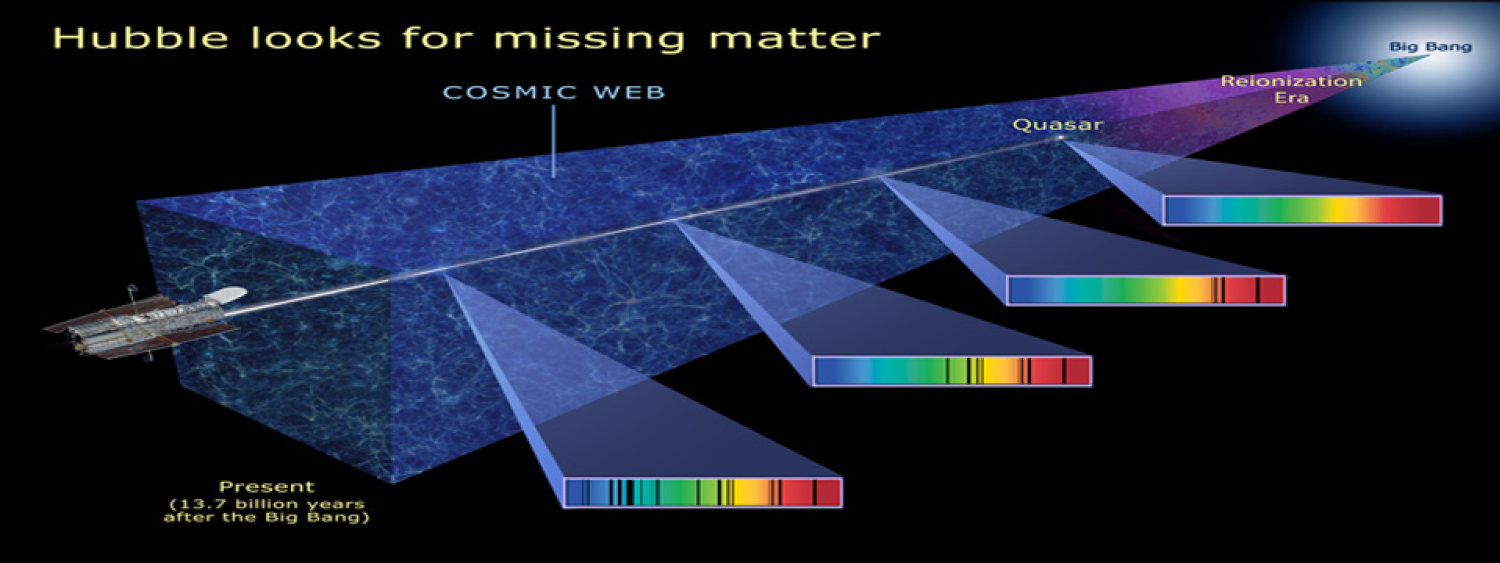
Those spectra are tell­tale "fingerprints" that vary, depending on the matter the light passes through and the motion of that matter. From those seemingly meager clues comes a wealth of information.

Linsky will use STIS to study "very young stars, a few million vears old." Our sun is middle­aged.

The researchers want to gain more information about how young suns behave, emitting substantially more ultraviolet and X­ray radiation "by factors of between 1,000 and 10,000," Linsky said, than their middle­aged counterparts.

The information will clarify how the Earth's natural systems formed and eventually gave birth to life on the planet. That information can be used to understand how life might form on another planet.

"And if the environment in which these proto­planets formed is different today, we want to know that," Linsky said.

STIS also has the capability to block out the brightness of stars so the instruments can record the surrounding information, which shows dusty disks that form planets.

"We can get 10 times or 20 times what we got with GHRS," Linsky said.

John Stocke, a CU professor in the Astrophysical, Planetary and Atmospheric Science Department, also will use STIS.

"We will do follow­up observations of gas clouds that were in voids where there are no galaxies," Stocke said. "It was previously thought that there was no matter in between galaxies."

Stocke's research team used the GHRS to find the clouds, which are providing clues about the formation of the universe as well as its ultimate fate.

"Our studies indicate there is as much matter in these clouds as there is in the luminous galaxies," Stocke said.

Some of them may be "primordial clouds," relatively undisturbed since the universe was formed. Others are probablv matter that was blown out of small galaxies that didn't have the gravity to hold the material.

Primordial clouds can give scientists an indication of how old the universe is by looking at the ratio of hydrogen to deuterium, an isotope of hydrogen.

Deuterium was created in the Big Bang and "over the course of time has only been destroyed," explained Linsky, who also is looking at the ratio. Deuterium is destroyed in the nuclear reactions inside stars. With knowledge of how many stars are in the universe and how fast they destroy deuterium, Linsky said, it is possible to determine an age.

However, that number is still hotly debated and the Hubble information will help narrow the range of possibilities.

The clouds containing material blown out of galaxies could reveal how far back stars were first formed, Stocke said.

Another astronomical problem is the amount of matter in the universe. If there is a lot of matter, the expanding universe will eventually run out of momentum and gravitv will pull it back, coalescing until there is another Big Bang. If there is little matter, the universe will keep expanding until it runs out of steam.

By most calculations, there should be more matter than has been observed, which led to the concept of "cold, dark matter."

"Most of the universe is dark matter," Linsky said. "It is in a form we're totally unfamiliar with, there is no radiation and it has a gravitational force, but we can't detect it."

Stocke will be trying to determine whether there is dark matter in the intergalactic clouds." They may or may not have dark matter," Stocke said.

Finding out may take another new instrument, however.

Stocke said his team will propose a new instrument to be installed in Hubble in 2002 that will allow examination of more stars, and more importantly, stars that will provide the best information.

With the new instrument, they will be able to look at dimmer stars that are farther away. The farther the better, Stocke said, because it increases the odds researchers will find a line of sight that intersects one of the gas clouds.

Stocke also is leading a team that still use NICMOS to "witness the birth of radio galaxies."

Nearby galaxies that emit radio waves have characteristics that make scientists think they have just been born. "We want to look at what the physical conditions are that would give rise to these," Stocke said.

The theory is that there are massive black holes at the center of these galaxies, a general phenomenon that has been confirmed with previous Hubble observations.

"We will be looking in the central regions of these galaxies," Stocke said. "There are a couple of possible explanations (for the radio emissions). One is that thev suffered recent collisions with other galaxies or there may be two black holes that are merging.

"The thrust of our project is very exploratory-let's go look and see what's there."