Universal Enlightenment
Ten-year-old Space Telescope
has Transformed Concepts
Katy Human
Daily Camera
May 7, 2000
The image to the right is Hubble's face-on snapshot
of the small spiral galaxy NGC 7742. Above, newborn star emerging
from "eggs" - dense, compact pockets of interstellar gas called
evaporating gaseous globules (EGGs) in the Eagle nebula, a region 7,000
light-years from Earth in the constellation Serpens.
 | |
This Hubble telescope snapshot of MyCn18, a
young planetary nebula,
reveals that the object has an hourglass shape with an intricate pattern
of "etchings" in its walls. A planetary nebula is the glowing relic of a
dying, sun-like star.
 | |
The Hubble telescope has spied a giant
celestial "eye," known as planetary nebula NGC 6751. Glowing in the
constellation Aquila, the nebula is a cloud of gas ejected several
thousand years ago from the hot star visible in its center. Planetary
nebulae have nothing to do with planets. They are shells of gas thrown
off by sun-like stars nearing the ends of their lives.
 | |
A telescope on board a satellite 375 miles above the Earth has revolutionized astrophysics, and our knowledge of the origins of the cosmos.
Praise gushes from the mouths of most scientists asked how the 10-year
old Hubble Space Telescope has affected their view of the universe.
Jim Crocker, an engineer with Ball Aerospace & Technologies Corp. who has supervised some of the Boulder company's work on Hubble instruments, said the space telescope lets astrophysicists see the universe clearly for the first time.
He compared Hubblelaunched 10 years ago last monthto his first pair of glasses.
"I will never forget that day in sixth grade when I went outside with new glasses on and I could see leaves on trees," Crocker said. "Before that, I didn't understand what people meant when they talked about what they saw."
Mike Shull, an astrophysicist at the University of Colorado who has logged many hours of Hubble observing time, compared his Hubble experiences to television.
"It's like going from that black and white, small little TV set that we watched as kids to a big color set," he said.
Images and data from groundbased telescopes and satellite-based instruments have led to important insights about the structure and origin of the universe. But no tool has been as important to astronomy as the Hubble Space Telescope, said David Leckrone, NASA's Hubble Space Telescope project scientist, who celebrated the telescope's anniversary at Ball Aerospace late last month.
"You can come up with a long list of things astronomers really knew before Hubble," Leckrone said, raising one eyebrow. "But the fact is, in virtually all these disciplines, there was no proof.
"Hubble has revolutionized every area of astronomy," he said. "We can see very clearly now the cycle of birth, death and rebirth of stars. We see very clearly the raw material from which solar systems form. We see super-massive black holeseven in our own galaxyand we've discovered that they are common in galaxies."
Images snapped by the space telescope have also mesmerized non-scientists.
"I don't quite understand why people are so moved and amazed," Leckrone said. "It may be that they now understand the universe's beauty. It may be that they now have a context for where they live."
Hubble science
The Hubble Space Telescope lived in the dreams of scientists for more than 40 years before it was finally built and then launched in 1990, Crocker said.
Lyman Spitzer, a researcher at Princeton University, began pushing for a space-based telescope in the late 1940s. His idea was to get instruments outside of Earth's atmosphere, which obscures light from outer space.
Shull was Spitzer's graduate student when, in the 1970s, it became apparent Congress would finally fund the telescope. Shull himself now works with data and images gathered by Hubble, which orbits about 375 miles above the Earth's surface.
Shull's work has been lauded as some of the most important to come from the space telescope.
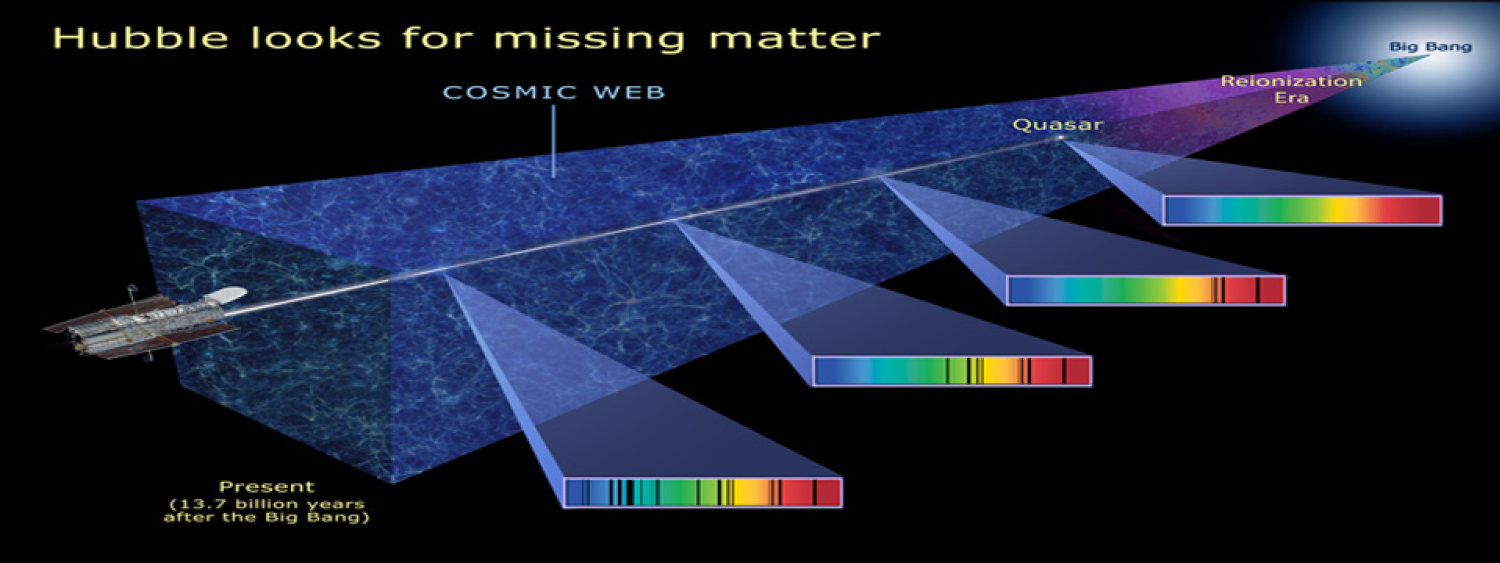
"We found that intergalactic gas clouds persist to the present day," Shull said. "Before Hubble, we thought they were only present in early universe, and then dissipated. But these things are not only surviving but they're everywhere. There's huge amounts of gas still out there, which means galaxies are still forming."
Shull said the telescope has also changed the way researchers think of star and planet formation.
"Most people thought the planets and sun formed at the same time," Shull said. "But you look at stars in Orion and you find protoplanetary discs that are still there, probably forming planets. So a star can form and there can still be gas around it, forming planets, later."
Leckrone said the telescope's eyes have glimpsed other forms of star birth, too.
"Hubble has shown us five or six ways to get a star," he said. All involve events that compress interstellar gas: Galaxy collisions, for example, or supernovas that create shock waves.
Jeff Linsky, a research professor in astrophysics at CU, said one of Hubble's most important discoveries is the age of the Universe.
"Did the universe start yesterday? Is it 6,000 years old, because the Bible says it is, or is it billions of years old?" Linsky asked. "I think Hubble has actually answered that question. We've got a number."
Most astrophysicists now put that number at 14 or 15 billion years old.
And by studying, with Hubble, the movements of distant galaxies, astronomers found that distant galaxies actually seem to be moving away from our own at an accelerating pace, Linsky said.
"There are no good explanations for that," he said. "It was a total surprise, though it's not fully confirmed yet "
Everyday Insight
Researchers like Shull have been delighted by Hubble's scientific insights, but everyday people have benefited as well according to Hubble proponents.
NASA's Frank Cepollina, a Hubble director at NASA's Goddard Space Flight Center in Maryland, says important technological advances have emerged from the Hubble mission.
Scientists working on imaging technology for Hubble developed an instrument now used to detect breast cancer at earlier stages than previously possible, he said.
And instruments used to build Hubble's high-quality optics are now key in computer chip manufacturing, Cepollina added. "These things keep the United States up there in terms of world class technology," he said.
NASA has also been inordinately successful at wowing the public with Hubble's pictures of the universe.
People across the country tape to their refrigerators images of glowing galaxies and tag pillars of space dust that serve as star nurseries. Hubble pictures will soon appear on U.S. postage stamps.
The space telescope's most famous image, of the Eagle Nebula, shows towering pillars of dust, the largest of which is 7 trillion miles tall.
"If you get someone to explain it to you, you can actually see stars forming," Crocker said of that picture. "The fact that there's structure at that scale in the universe, and the fact that there's beauty, I think, is inspirational."
Shull said his favorite picture, however, is one known as the Hubble Deep Field.
The image shows the most distant objects ever seen in optical light, including a galaxy that may have existed only a few hundred million years after the Big Bang, the event most astrophysicists believe created the universe.
"It's beautiful in a Jackson Pollack kind of way," Shull said. "The information in that image has created hundreds of papers that created whole new studies in understanding star formation, young universe.
"It's a time machine."
Ten years left
NASA will have spent about a billion on the Hubble Space Telescope by the official end of the mission in 2010, Leckrone said, about $500 million of which has gone to Ball Aerospace for instrument work.
After 2010, Hubble may continue collecting data, but NASA does not plan to maintain or improve after than, Leckrone said.
"Over 1,000 people here in 2 years worked on Hubble," Tom LaJeunesse, Ball Aerospace's director of Hubble Space Telescope programs, told a group of Ball employees last month. "It's been a great project for us.
He and Jerry Chodil, vice president of civil space systems at Ball, hope NASA's next venture, the Next Generation Space Telescope, will be even better for the company.
Ball and Lockheed-Martin are competing for a contract to build that telescope, Chodil said.
The new telescope will be much more distant from the Earth than the Hubble Space Telescope1 million miles away.
"Out there ... we can see the very faint signatures of the earliest universe," Chodil said.
And while Hubble's reflecting mirror is less than 8 feet across, Next Generation will have the equivalent of a 26-foot-diameter mirror, Chodil said.
"We'll be able to see further, deeper into space with higher resolution."
|