CASA Home Page
 
  Search:
  

Intergalactic Web of Gas Found

Evidence Presented at Research Conference in Boulder Today

By Andy Resnik, Associated Press
Mary Butler, Camera Staff Writer
Daily Camera
August 8, 2002

An X-ray telescope orbiting Earth a third of the way to the moon has taken the first pictures of an intergalactic web of gas that connects groups and clusters of galaxies, astronomers said.

The scientists who discovered the previously undetected web say it could lead to mapping the universe's dark matter, areas of space that cannot be seen but are known to exist because of the pull of gravity.

"We sort of knew that it must exist, but we hadn't see it before, ... The results are tantalizing," said Smita Mathur, an Ohio State University researcher who led one of four teams of scientists working on the project.

"It helps us understand how the galaxies and all the structures of the galaxies formed," she said.

Scientists believe dense knots of gas in the web eventually become galaxiees, said Mathur, who will present the discovery along with her colleagues at a research conference in Boulder today.

About 90 scientists have gathered for the Intergalactic Medium/Galaxy Connection conference, which started Wednesday night and continues through Saturday at the National Center for Atmospheric Research.

One of the key themes of the conference is "gas between the galaxies," said Mike Shull, director of University of Colorado's Astrophysical and Planetary Sciences Department. CU scientists have worked extensively on both NASA's Chandra X-ray telescope and the Hubble Space Telescope projects.

Both tools, Shull said, are key in detecting matter than scientists know exist but can't see.

Located billions of miles from earth, the web looks like a giant patch of fog suspended in space. The gas is 300,000 to 5 million degrees Calsius.

Dark matter could be behind the web in "rivers of gravity" that are cared into space over millions of years, said Wallace Tucker, science spokesman for NASA's Chandra X-ray Center, which controls the telescope from its Cambridge, Mass. facility.

Because the dark matter is the strongest source of gravity, it's holding the hot gas in this web," he said.

"It looks like a promising way to map out where it must be," said William Herbst an astronomer at
Wesleyan University in Middletown, Conn., who is not involved in the research.

He said the discovery "looks really exciting" because scientists are "confirming the existence of a certain component of the universe."

The web's gases contain most of the normal matter in the universe and more material than all of
the stars in the universe, scientists said.

"This is not a negligible amount. It's a lot of stuff," Herbst said.

Researchers at Ohio State, the University of Michigan, Harvard Unversity and the Massachusetts Institute of Technology worked on the project using the orbiting X-ray telescope.

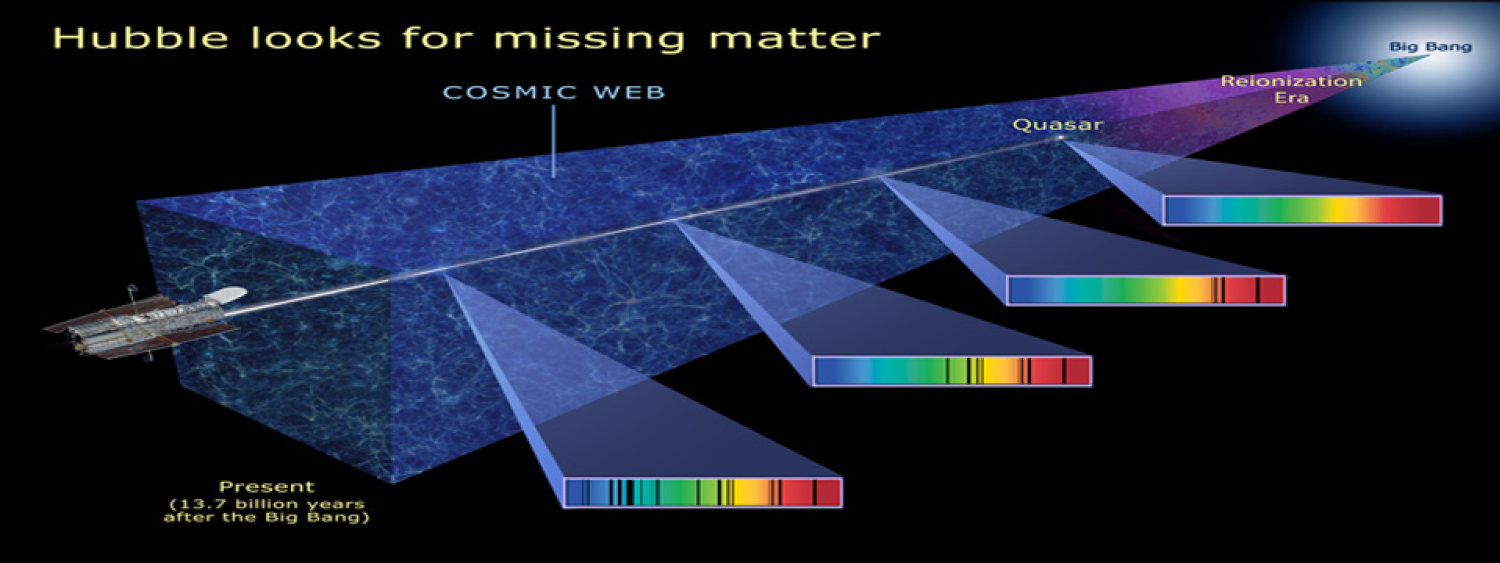
Mathur said the telescope, launched in July 1999, works like an X-ray machine in a doctor's office and detected the web of gas because it absorbed the light from objects behind it.

"We can see whatever matter is in between because the light gets absorbed," she said. "It's like the physician doing the X-ray of your hands. The X-rays come from the machine, it gets absorbed by your bones and you have a shadow."

Mathur said astronomers only have discovered part of the web. She didn't know how long it will take to find the rest.

"We can only look at a couple of directions," she said. "We haven't been able to map out the entire thing because the instruments are limited."