CASA Home Page
 
  Search:
  

Denver and the West

It's Hubble time for CU

By Ann Schrader
Denver Post Medical Science Writer
Wednesday, February 19, 1997
THE DENVER POST

With a second servicing mission completed, the Hubble Space Telescope was to be released lateTuesday night into a higher orbit with higher scientific expectations.

Scientists from the University of Colorado and others around the world are lining up to use the telescope's new capabilities, which will be available once powering-up sequences, focusing and other testing are completed in the next 30 to 45 days.

CU researchers did "very well" in winning new and improved Hubble observing time over the next year or so, CU astrophysicist Mike Shull said. Nine of the university's 47 proposals were among 200 chosen from a total of 1,300 proposals offered. The CU projects will represent about 5 percent of Hubble observing time.

"That's a 16 percent success rate," said Shull, a Member of the Hubble Time Allocation Committee. "We beat the odds."

Colorado connections don't stop there. Last Thursday, space shuttle Discovery astronauts installed instruments built by Broomfield -based Ball Aerospace and Technologies Corp.

One instrument is a near­infrared camera and multi­object spectrometer, the other a space telescope imaging spectrograph.

At 11:41 p.m. MST Tuesday, the space shuttle Discovery was to release the telescope into an orbit that is higher to reduce odds of atmospheric drag bringing it down.

The astronauts have done an "aliveness" test on the instruments, in which all the electrical circuits are turned on, but not brought up to full power. Temperature adjustments and focusing of instruments will follow.

With the new clarity loaded onto Hubble, scientists say they will be exploring everything from stars being born to peering through time to within a few billion years of the Big Bang.

"NASA is interested in the origins of life, the origins of planets, the origins of stars, the origins of galaxies and the origins of the universe," said CU's Jeff Linsky.

Ten years ago, Linsky joined a scientific team to write a proposal for the imaging spectrograph. One of his postdoctoral students was involved in calibrating it at Ball before it was shipped for launch.

The spectrograph converts light into component wavelengths, both optically and in the near­infrared and ultraviolet wave bands.

Linsky said the instrument replaces the first­generation Hubble's Goddard spectrograph, a faint­object spectrograph and the faint­object camera. The Goddard spectrograph, also built by Ball, blew a fuse a few days before the servicing mission.

Linsky plans to study the ultraviolet band within gas­surrounded stellar "nurseries" at recently formed stars-the way Earth's sun appeared when it was very young.

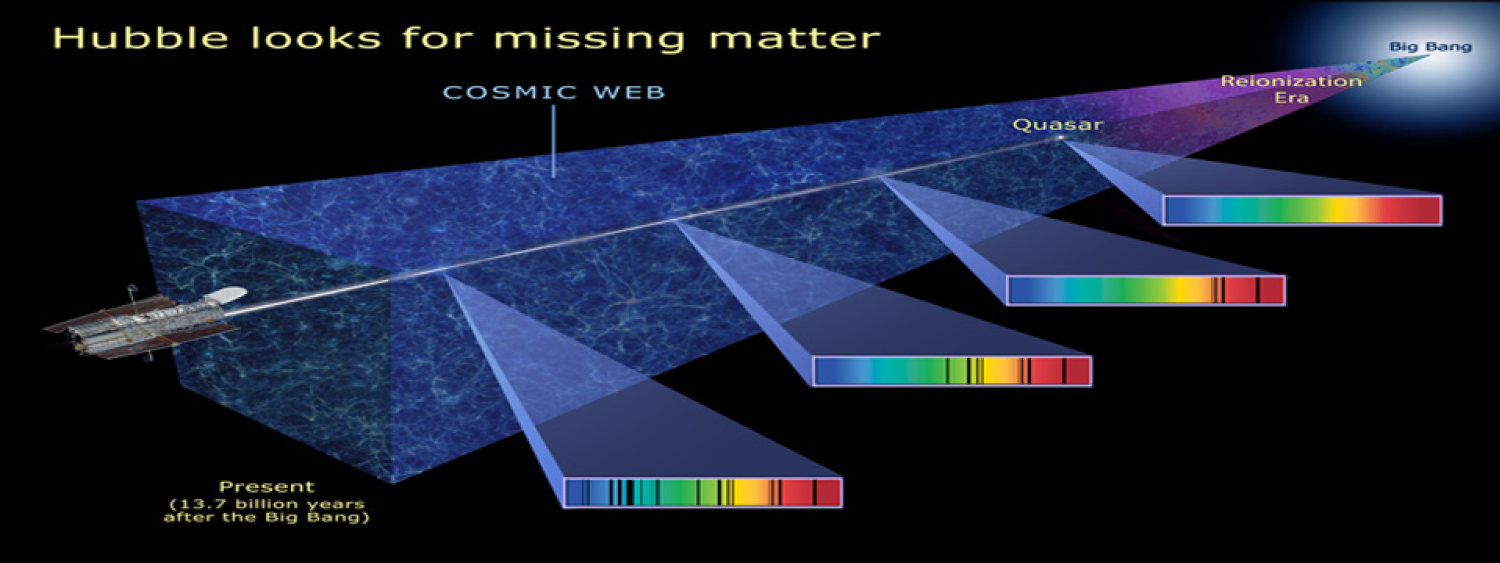
CU's Shull is among those who will examine 14 quasars-powerful light­emitting objects - to probe the formation of galaxies. "We will be using them as lighthouses whose beacons shine through the intergalactic medium," he said.

The group will investigate how gas clouds between galaxies collapse and form new stars and heavy elements.

With the new spectrograph, Shull said, "What would have taken us 30 days of Hubble time, we can now do in three days."

An advanced camera for surveys is being built by Ball for installation during Hubble's next pit stop, scheduled for 1999. CU scientists and Ball are working on a proposed instrument for the 2002 Hubble odyssey. Shull declined to talk about that instrument, but promised it would be "something amazing" that improves Hubble observations "by yet­another factor of 10."