Problem Set 6
ASTR 3730
Read Chapters 15, 17, 18
1. Calculate the moment of inertia of a neutron star (I=2MR2/5). Calculate the energy of spin of the Crab Pulsar (E=Iw2/2) where the period is 0.033 seconds. The Crab is slowing at a rate that will stop its spin in 2500 years. Calculate its power lost.
2. The acceleration g of a freely falling body near a black hole is given by:
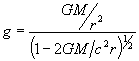
Show that far from the event horizon this reduces to the usual Newtonian form. Show the force becomes infinite at the event horizon.
3. Let dt¥ be the time interval elapsed for an observer at infinity. The elapsed time for a local observer is:
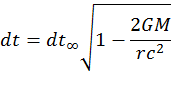
Show that a local observer far from the black hole ages at the same rate as the observer at infinity, and that as the local observer approaches the event horizon aging stops as observed from infinity.
4. A particle falling from infinity takes time
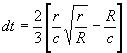 to fall from
radius r to the event horizon at radius R. Calculate dt for a particle falling from
10km onto a one solar mass black hole.
to fall from
radius r to the event horizon at radius R. Calculate dt for a particle falling from
10km onto a one solar mass black hole.
5. Using:
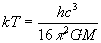 as derived by
Hawking, calculate the evaporation timescale for a one solar mass black hole.
as derived by
Hawking, calculate the evaporation timescale for a one solar mass black hole.
6. If you were to take a spectrum of a reflection nebula, would you see absorption lines, emission lines, or no spectral lines? How would this help to show that the illumination is by reflection from the central star?
7. To calculate the size of a Stromgren sphere, idealize the problem by considering a pure hydrogen gas of uniform density which surrounds a single hot star. Let N* be the number of ultraviolet photons beyond the Lyman limit which leave per unit time from the central star. Assume that each such photon will ultimately ionize one and only one hydrogen atom. Let R be the number or recombinations of protons and electrons into hydrogen atoms per unit volume per unit time. In a steady state, the total number of recombinations in the Stromgren sphere of radius r must balance the total number of ionizations:
R(4pr3/3)=N*
Given R and N*, this equation would allow us to find r. To obtain R, let us note that recombination at interstellar densities is a two-body process (involving for each recombination one proton and electron). Thus the number of recombinations per unit volume R must be proportional to the product of the number densities of protons and electrons, npne. The proportionality factor is denoted by a, and it is called the "recombination coefficient." Thus
R=anpne=ane2
Where we require np=ne for overall charge neutrality. Show now that the Stromgren radius r is given by the formula
r = (3N*/4pane2)1/3
The "recombination coefficient" a is a function of the temperature of the hydrogen plasma. For temperatures characteristic of Galactic HII regions, a has the approximate value 3x10-13 cm3sec-1. Assume ne=10cm-3; compute r when N*= 3x1049 sec-1 (O5 V star), N* = 4x1046sec-1 (B0 V star) and N* = 1x1039 sec-1 (G2V star). Convert your answer to light-years. What types of main-sequence stars have appreciable HII regions?
8. Suppose a spherical shell identified as a supernova remnant is observed with radius r and with outward expansion speed v. Assume the mass density of the ambient medium to have the uniform value r0; then the supernova remnant must have swept up mass M = r04pr3/3. Let the original mass M0 be ejected at speed v0. If we ignore communication between different parts of the shell (via the thermal pressure of the hot interior), and suppose that each piece of the shell preserves its outward linear momentum as it sweeps up more material initially at rest, we have the snowplow model. Show that the snowplow model implies
(M+M0)v=M0v0
The original kinetic energy E0 of the ejected material equals M0v02/2. The present kinetic energy E of the shell equals (M+M0)v2/2. Show that the ratios E/E0 and v/v0 are given by
E/E0=v/v0=M0/(M+M0)
In a typical supernova explosion, M0=4M¤ worth of matter might be ejected from the central star at speeds v0=5000km/s. What is the original kinetic energy E0? How much mass M would have to be swept up to bring the supernova shell speed v to a value of 10km/s, which is typical of the random velocities of t interstellar clouds? In the process, by what factor is E reduced from E0? What must happen to the lost energy in the snowplow model?
What is the radius r when v =10km/s if r0=2x10-24g/cm3? Convert your answer to parsecs.
For M>> M0, show that v is inversely proportional to r3. With the time-rate change of radius proportional to r-3, show the age t of the remnant will four times shorter than had it expanded to radius r at a constant speed. Compute t for our hypothetical supernova remnant.
9. a) At what velocity must a hydrogen atom hit an ice cube to sputter off a
water molecule, given that the boiling point of water is 400K?
b) How far from a one solar mass star does the orbital velocity equal the
velocity of part a?
c) The temperature of Saturn is about 100K. How massive would an accretion core
have to be (at 100K) to hold a hydrogen atom against thermal escape? Assume a
core density of 3g/cc. How does this mass compare to Saturn's mass?